
Regulation of glycogen metabolism, muscle
GraphML PNG SVG CellDesigner SBML SBGN-ML Annotation Newt MINERVA
Regulation of glycogen metabolism, liver
GraphML PNG SVG CellDesigner SBML SBGN-ML Annotation Newt MINERVA
Description
Intracellular glycogen stores contribute to blood-glucose homeostasis during fasting, provide energy for muscle contraction and support a broad range of cellular activities in many tissues. Glycogen synthase and glycogen phosphorylase control glycogen synthesis and breakdown, respectively. Glycogen phosphorylases, including the liver, muscle and brain forms PYGL, PYGM and PYGB, catalyse glycogen breakdown to glucose-1-phosphate.
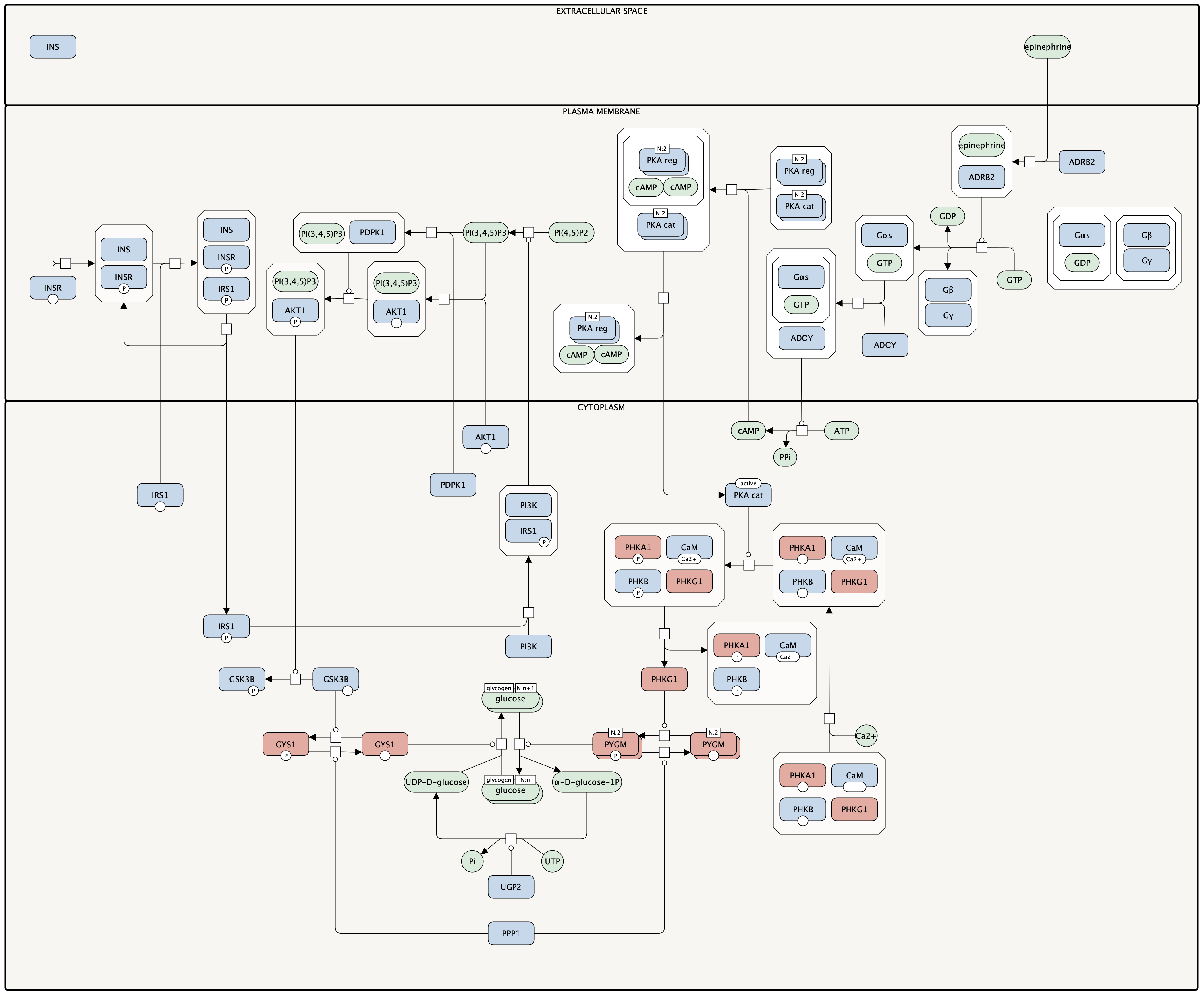
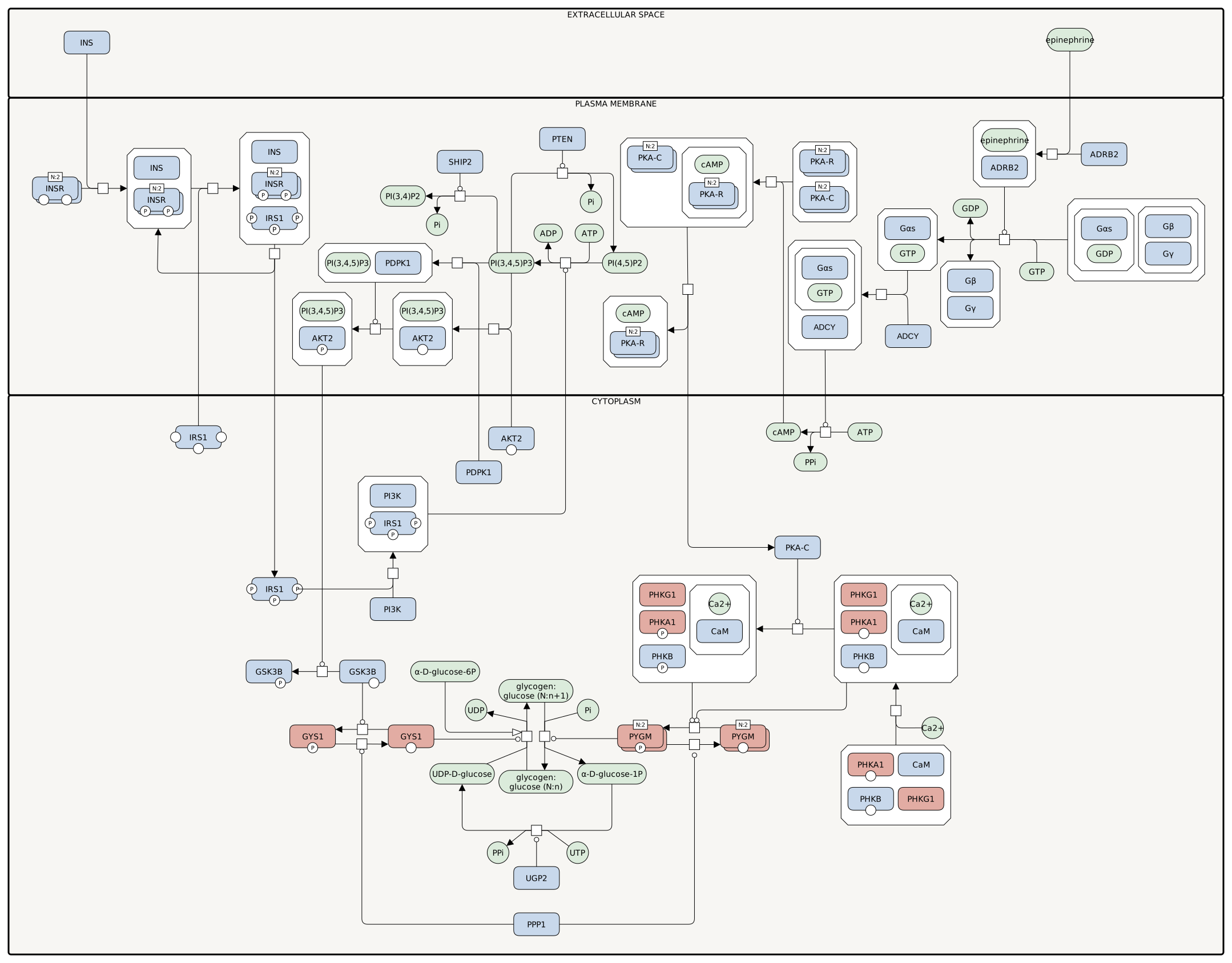
The muscle map represents regulation through insulin signalling, adrenergic signalling and calcium-dependent activation of phosphorylase kinase. Epinephrine activates the ADRB2-Gs-adenylate cyclase-cAMP-PKA pathway, promoting phosphorylation and activation of muscle glycogen phosphorylase PYGM, while insulin signalling through PI3K-PDPK1-AKT2 regulates glycogen synthase through inhibition of GSK3B.
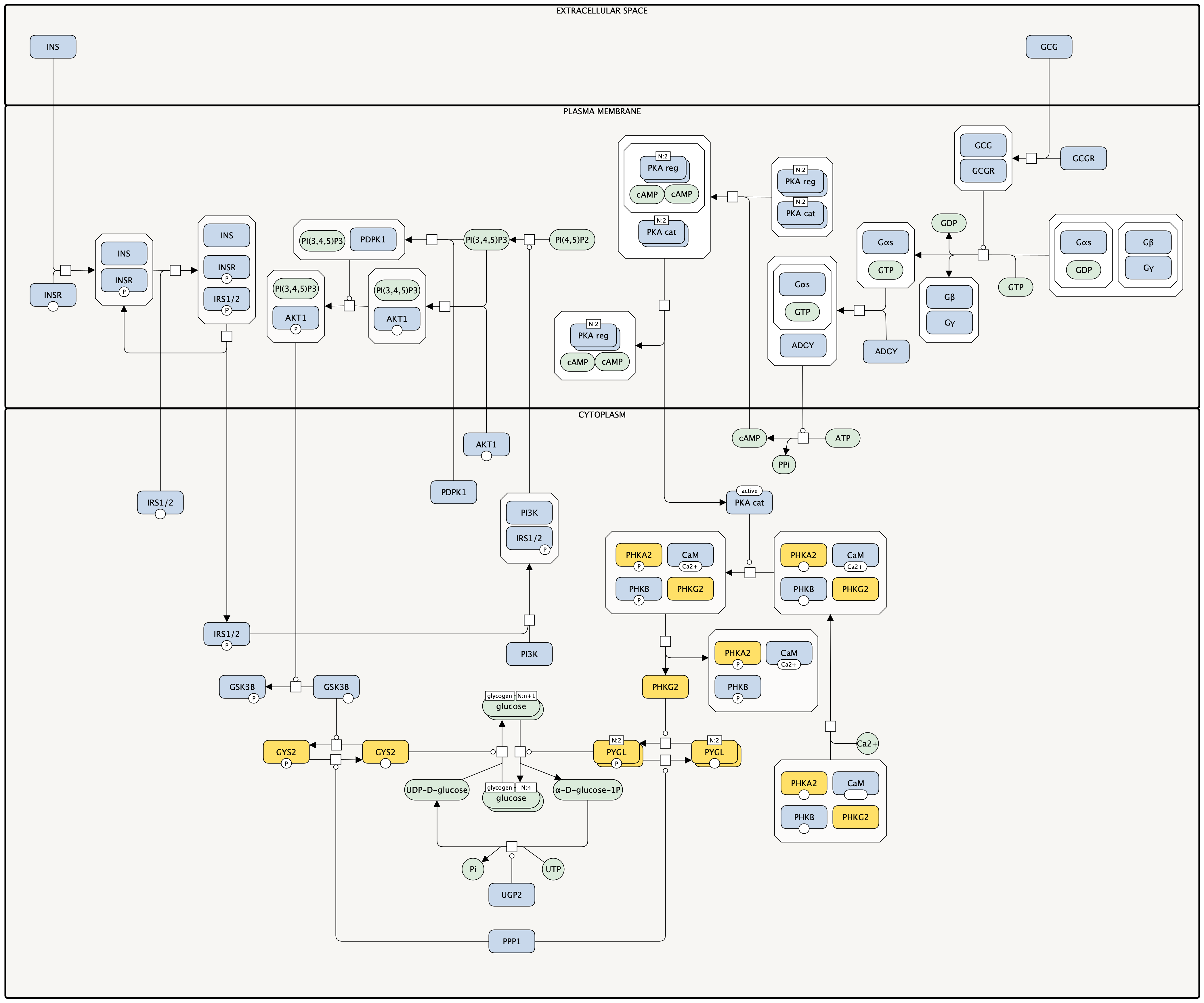
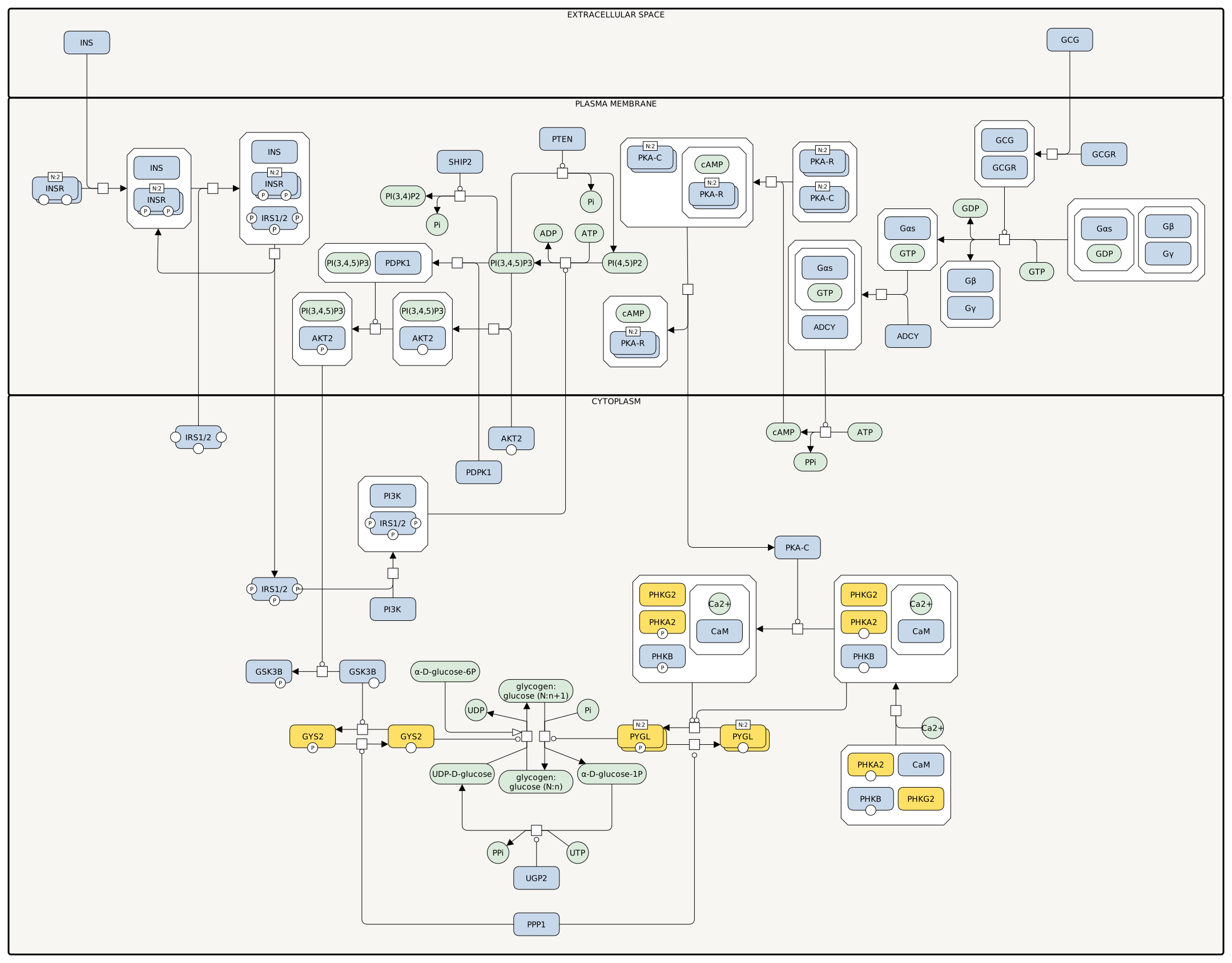
The liver map represents complementary regulation by insulin and glucagon. Glucagon signalling through GCGR activates the Gs-adenylate cyclase-cAMP-PKA pathway and promotes glycogen utilisation, whereas insulin signalling favours glycogen synthesis. In liver, the corresponding major metabolic enzymes are glycogen synthase GYS2 and glycogen phosphorylase PYGL.
References
- Adeva-Andany MM, González-Lucán M, Donapetry-García C, Fernández-Fernández C, Ameneiros-Rodríguez E. Glycogen metabolism in humans. BBA Clin. 2016 Jun;5:85-100. doi: 10.1016/j.bbacli.2016.02.001. PMID: 27051594.
- Alessi DR, James SR, Downes CP, Holmes AB, Gaffney PR, Reese CB, Cohen P. Characterization of a 3-phosphoinositide-dependent protein kinase which phosphorylates and activates protein kinase Balpha. Curr Biol. 1997 Apr;7(4):261-9. doi: 10.1016/s0960-9822(06)00122-9. PMID: 9094314.
- Bouzakri K, Zachrisson A, Al-Khalili L, Zhang BB, Koistinen HA, Krook A, Zierath JR. siRNA-based gene silencing reveals specialized roles of IRS-1/Akt2 and IRS-2/Akt1 in glucose and lipid metabolism in human skeletal muscle. Cell Metab. 2006 Jul;4(1):89-96. doi: 10.1016/j.cmet.2006.04.008. PMID: 16814735.
- Brushia RJ, Walsh DA. Phosphorylase kinase: the complexity of its regulation is reflected in the complexity of its structure. Front Biosci. 1999 Sep 15;4:D618-41. doi: 10.2741/brushia. PMID: 10487978.
- Bulik S, Holzhütter HG, Berndt N. The relative importance of kinetic mechanisms and variable enzyme abundances for the regulation of hepatic glucose metabolism—insights from mathematical modeling. BMC Biol. 2016 Mar 2;14:15. doi: 10.1186/s12915-016-0237-6. PMID: 26935066.
- Cho H, Mu J, Kim JK, Thorvaldsen JL, Chu Q, Crenshaw EB 3rd, Kaestner KH, Bartolomei MS, Shulman GI, Birnbaum MJ. Insulin resistance and a diabetes mellitus-like syndrome in mice lacking the protein kinase Akt2 (PKB beta). Science. 2001 Jun;292(5522):1728-31. doi: 10.1126/science.292.5522.1728. PMID: 11387480.
- Cross DA, Watt PW, Shaw M, van der Kaay J, Downes CP, Holder JC, Cohen P. Insulin activates protein kinase B, inhibits glycogen synthase kinase-3 and activates glycogen synthase by rapamycin-insensitive pathways in skeletal muscle and adipose tissue. FEBS Lett. 1997 Apr 7;406(1-2):211-5. doi: 10.1016/s0014-5793(97)00240-8. PMID: 9109420.
- Esposito DL, Li Y, Cama A, Quon MJ. Tyr612 and Tyr632 in human insulin receptor substrate-1 are important for full activation of insulin-stimulated phosphatidylinositol 3-kinase activity and translocation of GLUT4 in adipose cells. Endocrinology. 2001 Jul;142(7):2833-40. doi: 10.1210/endo.142.7.8283. PMID: 11416002.
- Grempler R, Zibrova D, Schoelch C, van Marle A, Rippmann JF, Redemann N. Normalization of prandial blood glucose and improvement of glucose tolerance by liver-specific inhibition of SH2 domain containing inositol phosphatase 2 (SHIP2) in diabetic KKAy mice. Diabetes. 2007 Sep;56(9):2235-41. doi: 10.2337/db06-1660. PMID: 17596404.
- Hubbard SR. Crystal structure of the activated insulin receptor tyrosine kinase in complex with peptide substrate and ATP analog. EMBO J. 1997 Sep;16(18):5572-81. doi: 10.1093/emboj/16.18.5572. PMID: 9312016.
- Hubbard SR. The insulin receptor: both a prototypical and atypical receptor tyrosine kinase. Cold Spring Harb Perspect Biol. 2013 Mar;5(3):a008946. doi: 10.1101/cshperspect.a008946. PMID: 23457259.
- Jiang G, Zhang BB. Glucagon and regulation of glucose metabolism. Am J Physiol Endocrinol Metab. 2003 Apr;284(4):E671-8. doi: 10.1152/ajpendo.00492.2002. PMID: 12626323.
- KEGG: Glucagon signaling pathway. KEGG:hsa04922.
- Kumar A, Harris TE, Keller SR, Choi KM, Magnuson MA, Lawrence JC Jr. Muscle-specific deletion of rictor impairs insulin-stimulated glucose transport and enhances Basal glycogen synthase activity. Mol Cell Biol. 2008 Jan;28(1):61-70. doi: 10.1128/MCB.01405-07. PMID: 17967879.
- Lane LA, Nadeau OW, Carlson GM, Robinson CV. Mass spectrometry reveals differences in stability and subunit interactions between activated and nonactivated conformers of the (αβγδ)4 phosphorylase kinase complex. Mol Cell Proteomics. 2012 Dec;11(12):1768-76. doi: 10.1074/mcp.M112.021394. PMID: 22964223.
- Maehama T, Dixon JE. The tumor suppressor, PTEN/MMAC1, dephosphorylates the lipid second messenger, phosphatidylinositol 3,4,5-trisphosphate. J Biol Chem. 1998 May;273(22):13375-8. doi: 10.1074/jbc.273.22.13375. PMID: 9593664.
- McCorvie TJ, Loria PM, Tu M, Han S, Shrestha L, Froese DS, Ferreira IM, Berg AP, Yue WW. Molecular basis for the regulation of human glycogen synthase by phosphorylation and glucose-6-phosphate. Nat Struct Mol Biol. 2022 Jul;29(7):628-638. doi: 10.1038/s41594-022-00799-3. PMID: 35835870.
- MetaCore: Glycogen metabolism. MetaCore:919.
- Nadeau OW, Carlson GM, Gogol EP. A Ca(2+)-dependent global conformational change in the 3D structure of phosphorylase kinase obtained from electron microscopy. Structure. 2002 Jan;10(1):23-32. doi: 10.1016/s0969-2126(01)00678-5. PMID: 11796107.
- Newgard CB, Hwang PK, Fletterick RJ. The family of glycogen phosphorylases: structure and function. Crit Rev Biochem Mol Biol. 1989;24(1):69-99. doi: 10.3109/10409238909082552. PMID: 2667896.
- Pesesse X, Moreau C, Drayer AL, Woscholski R, Parker P, Erneux C. The SH2 domain containing inositol 5-phosphatase SHIP2 displays phosphatidylinositol 3,4,5-trisphosphate and inositol 1,3,4,5-tetrakisphosphate 5-phosphatase activity. FEBS Lett. 1998 Oct;437(3):301-3. doi: 10.1016/s0014-5793(98)01255-1. PMID: 9824312.
- Raz I, Katz A, Spencer MK. Epinephrine inhibits insulin-mediated glycogenesis but enhances glycolysis in human skeletal muscle. Am J Physiol. 1991 Mar;260(3 Pt 1):E430-5. doi: 10.1152/ajpendo.1991.260.3.E430. PMID: 1900669.
- Reactome: Glucagon signaling in metabolic regulation. Reactome:R-HSA-163359.
- Reactome: Glycogen metabolism. Reactome:R-HSA-8982491.
- Reactome: PI3K-containing complexes phosphorylate PIP2 to PIP3. Reactome:R-HSA-109699.
- Stiles B, Wang Y, Stahl A, Bassilian S, Lee WP, Kim YJ, Sherwin R, Devaskar S, Lesche R, Magnuson MA, Wu H. Liver-specific deletion of negative regulator Pten results in fatty liver and insulin hypersensitivity. Proc Natl Acad Sci U S A. 2004 Feb;101(7):2082-7. doi: 10.1073/pnas.0308617100. PMID: 14769918.
- Sun XJ, Crimmins DL, Myers MG Jr, Miralpeix M, White MF. Pleiotropic insulin signals are engaged by multisite phosphorylation of IRS-1. Mol Cell Biol. 1993 Dec;13(12):7418-28. doi: 10.1128/mcb.13.12.7418-7428.1993. PMID: 7504175.
- von Wilamowitz-Moellendorff A, Hunter RW, García-Rocha M, Kang L, López-Soldado I, Lantier L, Patel K, Peggie MW, Martínez-Pons C, Voss M, Calbó J, Cohen PT, Wasserman DH, Guinovart JJ, Sakamoto K. Glucose-6-phosphate-mediated activation of liver glycogen synthase plays a key role in hepatic glycogen synthesis. Diabetes. 2013 Dec;62(12):4070-82. doi: 10.2337/db13-0880. PMID: 23990365.
- Wan M, Leavens KF, Hunter RW, Koren S, von Wilamowitz-Moellendorff A, Lu M, Satapati S, Chu Q, Sakamoto K, Burgess SC, Birnbaum MJ. A noncanonical, GSK3-independent pathway controls postprandial hepatic glycogen deposition. Cell Metab. 2013 Jul;18(1):99-105. doi: 10.1016/j.cmet.2013.06.001. PMID: 23823480.
- White MF, Livingston JN, Backer JM, Lauris V, Dull TJ, Ullrich A, Kahn CR. Mutation of the insulin receptor at tyrosine 960 inhibits signal transmission but does not affect its tyrosine kinase activity. Cell. 1988 Aug;54(5):641-9. doi: 10.1016/s0092-8674(88)80008-4. PMID: 2842060.
- Wijesekara N, Konrad D, Eweida M, Jefferies C, Liadis N, Giacca A, Crackower M, Suzuki A, Mak TW, Kahn CR, Klip A, Woo M. Muscle-specific Pten deletion protects against insulin resistance and diabetes. Mol Cell Biol. 2005 Feb;25(3):1135-45. doi: 10.1128/MCB.25.3.1135-1145.2005. PMID: 15657439.
- Yeaman SJ, Cohen P. The hormonal control of activity of skeletal muscle phosphorylase kinase. Phosphorylation of the enzyme at two sites in vivo in response to adrenalin. Eur J Biochem. 1975 Feb;51(1):93-104. doi: 10.1111/j.1432-1033.1975.tb03910.x. PMID: 1122918.
- Zois CE, Harris AL. Glycogen metabolism has a key role in the cancer microenvironment and provides new targets for cancer therapy. J Mol Med (Berl). 2016 Feb;94(2):137-54. doi: 10.1007/s00109-015-1377-9. PMID: 26882899.
Contributors
Vasundra Touré1,2, Luiz Ladeira3, Tatiana Serebriyskaya4, Valeriya Berzhitskaya4, Alexander Mazein5,6, John Albanese7
Affiliations
- 1Norwegian University of Science and Technology, Trondheim, Norway
- 2SIB Swiss Institute of Bioinformatics, Lausanne, Switzerland
- 3Biomechanics Research Unit, GIGA In Silico Medicine, University of Liège, Liège, Belgium
- 4Systems Biology and Translational Medicine, EPAM Systems, Inc., Newtown, USA
- 5Luxembourg Centre for Systems Biomedicine, University of Luxembourg, Belvaux, Luxembourg
- 6Department of Cancer Research, Luxembourg Institute of Health, Strassen, Luxembourg
- 7University of Connecticut School of Medicine, Farmington, USA